 All the lenses I tried!
2,237 photos, $11,000+ of Canon gear and a whoooooole lotta learning at the Pacific Airshow!
I went to the Pacific Airshow on the Gold Coast with one very simple goal:
Take some great photographs of planes.
Simple, right?
Well… not quite.
I came home with 2,237 photographs, a very sore arm, a much greater respect for aviation photographers, a new appreciation for fast telephoto lenses, and probably about 20 photographs that I can honestly say, “Yeah… they’re okay.”
And you know what?
I absolutely loved it! I would do it again tomorrow.
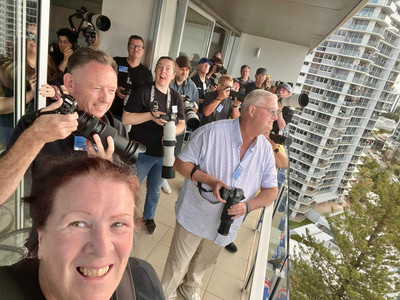 A fabulous cohort!
The opportunity
A fabulous cohort!
The opportunity
I joined a photographer cohort for the Pacific Airshow for the experience, and it turned out to be one of those photographic days that gives you far more than you expect.
Our group was based on the 13th floor of One The Esplanade on the Gold Coast, overlooking the entire stretch of beach.
There were ten photographers and nine representatives, and between us there were well over a hundred cameras and lenses available to use.
And these weren't just the cameras and lenses most of us would normally have sitting in our camera bags.
There was some serious glass.
The sort of glass that makes you look at the price tag and quietly wonder whether perhaps photography really is an expensive hobby.
I was given the opportunity to try whatever I wanted.
As a Canon photographer, I originally, I had planned to have a play with different camera systems too. I particularly wanted to try Sony, because I don't often get the opportunity to pick up cameras from other brands and see how they feel.
But then the planes started flying.
And I very quickly realised that I had enough to learn without throwing an unfamiliar camera system into the mix!
I (along with the reps guidance) chose the brand-new Canon EOS R6 Mark III, and that was already unfamiliar enough in this particular situation.
However, my major challenge wasn't the camera.
My challenge was getting a very fast-moving aircraft into the frame, keeping it there, and getting it in focus.
Repeatedly.
Preferably before it disappeared.
Aviation photography is HARD!
I have photographed motorsport before, including sprint cars.
I thought that would give me at least a little head start.
It didn't.
Well, perhaps it did, but only enough to give me false confidence.
Airplanes are fast.
And they don't politely stay at a nice distance while you compose your shot haha.
They come towards you.
They cross your field of view.
They change direction.
They disappear.
And when you're using a huge telephoto lens, finding them in the first place can be an achievement.
So I decided to start with something familiar.
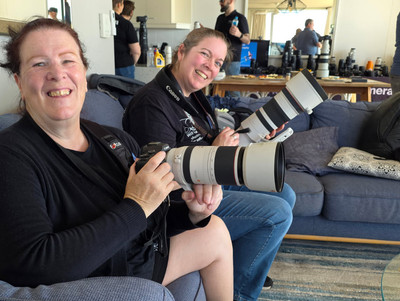 Lens trial number 3 I think ;)
The Canon RF100-400mm
I picked up the 100-400mm first because it was the closest thing to what I already use.
I have a 75-300mm, so the 100-400mm felt like a logical starting point.
I even told the representative that I wanted to photograph a plane or two with something familiar first, just to get used to the speed and movement before I started experimenting.
That turned out to be a very good decision.
At least I could actually find the planes!
The 100-400mm felt manageable, familiar and relatively comfortable.
And it made me realise something quite important.
Sometimes the most expensive lens isn't necessarily the lens that makes the most sense for you.
But I wasn't finished experimenting.
Then I picked up the 200-800mm.
Oh.
My.
Goodness.
The 200-800mm.
I had visions of getting some amazing close-up photographs.
Instead, I spent an awful lot of time trying to find the aircraft in the viewfinder.
By the time I found it…
it was gone. 😂
The sheer reach of the lens was incredible, but for someone who isn't accustomed to working with that kind of focal length, it was a serious learning curve.
And it was heavy.
Really heavy.
I persevered for about 15 minutes because, frankly, I wasn't going to let a lens beat me.
But eventually I admitted defeat.
For now.
I swapped it out.
Next came the 100-500mm.
And this one clicked.
It was still heavy - I won't pretend otherwise, but it was manageable.
More importantly, I could actually work with it.
I could find the planes.
I could track them.
I could get enough reach to make the aircraft fill the frame. Almost ;)
And I kept coming back to it.
Of all the lenses I tried on the day, this was my favourite.
And when I later thought about the value of the equipment I was using, I realised that at one point I was holding approximately $11,000 worth of camera and lens.
My word!
I don't think my usual camera bag has ever been worth anywhere near that.
And there I was, standing on the 13th floor of a Gold Coast building, waving it around trying to keep an aircraft in the frame.
No pressure!
The 100-300mm - beautiful glass, but perhaps the wrong situation
I also tried the 100-300mm f/2.8, which is seriously beautiful glass.
This is one of those lenses where you can feel the quality before you even take a photograph.
But for the airshow, I found it quite heavy and, for what I was trying to do, I didn't have the reach I wanted.
I suspect I was using it at the wrong time.
Just when I had changed lenses, the group aircraft came back through, along with some of the slower-moving aircraft, including the Hercules.
Of course.
That's photography, isn't it?
You change lenses and suddenly the perfect subject appears.
And then came the 600mm prime.
Finally, I tried the 600mm prime.
And my first reaction?
“My goodness, this is light!”
Compared with some of the other enormous lenses I'd been wrestling with, it felt almost ridiculously light.
It was also wonderfully fast and gave me an entirely different perspective.
But there was a catch.
It was a prime lens, so I was locked into that focal length.
And while it was fantastic for what I was doing at that moment, I couldn't really see myself using a lens costing around $11,000 in my everyday photography life enough to justify it.
Amazing lens?
Absolutely.
A lens I need?
Not justifiably!
At least not yet!
Learning to blur the propellers
Somewhere around the middle of the day, I was given another challenge.
And this one was completely different again.
Up until then, most of my photographs had been taken at very fast shutter speeds, generally around 1/1500 to 1/2500 sec at f/9, because I was trying to freeze the aircraft and get them sharp.
But then the representatives started teaching me about something I hadn't really considered.
Getting the aircraft sharp while deliberately blurring the propellers which I guess is what many fabulous aviation photographers achieve. Mind you, I also learned they take many of the aircraft on burst mode. I didn't - maybe next time I will. I took 2,237 photos - they would have taken thousands more.
Anyway, back to point. :)
The idea is to slow the shutter speed right down, pan with the aircraft and keep the aircraft itself sharp while allowing the propellers to show movement.
And suddenly I had another whole skillset to learn!
Instead of the very fast shutter speeds I'd been using, I was knocking the shutter speed right down, as low as 1/40 second.
One fortieth of a second.
With an aircraft moving through the sky.
And I was supposed to keep it sharp.
Haha.
Let's just say… it was not easy.
I tried it around the middle of the day, and then had another go towards the end, determined to see if I could improve.
I think I got one reasonable photograph where I was actually getting the effect I was after.
One.
But that one photograph was enough to show me what was possible.
And now I have another thing to practise.
Because getting the aircraft sharp while showing movement in the propellers through panning is a completely different skill again.
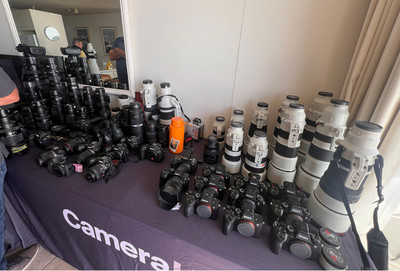 Only a small selection in the photo!
The camera decision
Only a small selection in the photo!
The camera decision
The camera itself was another interesting part of the day.
I was using the brand-new Canon EOS R6 Mark III for the entire session.
Originally, I had been excited about trying different camera brands, particularly Sony.
But once the aircraft started coming at us, I quickly changed my mind.
Trying to learn a new camera while simultaneously learning aviation photography seemed like setting myself up for failure.
So instead, I decided to stick with the R6 Mark III and experiment with the lenses.
And I think that was the right decision.
I already had enough going on trying to understand the tracking, the speed, the framing and the sheer chaos of getting an aircraft where I wanted it.
One new variable at a time was plenty!
The people made it even better
One of the things I really loved about the day was the cohort itself.
There were a couple of other photographers there who, like me, were doing aviation photography for the first time.
But we were also surrounded by some very, very, VERY experienced aviation photographers.
Some of them actually make a living from aviation photography.
And rather than feeling intimidating, it was fantastic.
They were helpful.
They shared their knowledge.
They offered advice.
They talked through what they were doing and why.
And having that mix of people, some of us learning the basics and others who were incredibly experienced — made the whole day even better.
There was no expectation that everyone should already know what they were doing.
We were there to learn and play and experiment with the different equipment.
And I certainly did.
The planes just kept coming
And the best thing about the whole experience?
There was no shortage of opportunities.
The planes were non-stop.
Just when you thought you'd had enough time to breathe, another aircraft was coming through.
That meant there was plenty of opportunity to experiment.
And plenty of opportunity to fail.
Which, as it turns out, was exactly what I needed.
Because aviation photography is something I haven't done before.
And you simply can't expect to be brilliant at something you've never practised.
2,237 photographs later…
When I got home and started going through the photographs, reality hit.
2,237 photographs.
I knew before I started that there would be plenty of failures.
There were.
Lots.
I whittled that amount down to 999 photos! Took two days! And then from them, I edited about 250ish. And of them. about 5 are what I would class as - good. :)
There were the obvious ones that were completely blurred.
Deleted.
There were photographs where the plane was little more than a tiny dot in the sky.
Deleted.
There were photographs where I had clearly lost the aircraft completely.
Deleted.
There were plenty where I had the plane… but not quite in focus.
Deleted.
And then there were the ones that made me hesitate.
Not great.
Not terrible.
Just…
“Yeah. That's okay.”
And I kept some of those.
Why I kept the bad ones
Normally, I'd probably be ruthless.
If a photograph isn't good enough, why keep it?
But this time I decided to do something different.
I kept some of the photographs that weren't particularly good.
Not because they're portfolio-worthy.
They aren't.
But because this was my first time photographing aircraft.
And one day, hopefully, I'll look back at them and think:
“Oh, look what I was doing back then!”
That's important to me.
Photography is a journey.
Sometimes we forget how much we improve because we're always looking at where we want to go next.
Keeping a few of these early attempts gives me a benchmark.
Maybe a year from now I'll photograph another airshow and have 50 good photographs.
Maybe two years from now I'll have 200.
Maybe I'll look at these first attempts and laugh.
I hope so.
Because that will mean I've improved.
The goodie bag was pretty good too!
It wasn't just about the cameras and lenses.
Lunch was provided, there were drinks throughout the day, and we were also given a fantastic goodie bag.
And there was one item in particular that caught my attention.
A 64GB fast SD card valued at around $199.
Now, that's the sort of memory card I normally look at in the camera store and think:
“That's lovely… but I'll stick with the cheaper one.”
There are plenty of less expensive cards available.
They're just slower.
So finding one of those in the goodie bag was a pretty nice surprise.
There were also pens, a notebook, mats and some great little camera and lens badges.
It was a lovely extra touch.
So, would I do it again?
Absolutely.
In fact, I think the biggest thing I took away from the day wasn't a particular photograph or even a particular piece of equipment.
It was the realisation that I want to do this again.
Aviation photography is hard.
Really hard.
But it's also incredibly exciting.
There's something about standing there waiting for an aircraft to appear, trying to find it through a long lens, tracking it across the sky and hoping, really hoping, that you've nailed the focus.
And then checking the image.
Sometimes…
Yes!
Other times…
Nope.
Delete.
Try again.
And again.
And again.
That's photography.
My favourite lens versus the sensible choice
If money were no object?
I'd probably choose the 100-500mm.
That was my favourite.
It gave me the reach I wanted without feeling completely unmanageable, and I kept going back to it throughout the day.
But if we're talking about what makes sense for my photography and my budget?
The 100-400mm wins.
It's much closer to what I'm already comfortable with, gives me a useful range and is something I could realistically use for a much wider variety of subjects.
So, for now, I'll stick with reality.
Although I won't lie…
That 100-500mm is still in the back of my mind.
And now I need to practice.
The Pacific Airshow has definitely given me the aviation photography bug.
I didn't walk away thinking I had mastered it.
Quite the opposite.
I walked away thinking: I really need to practice this.
And that's probably the best possible result from a photography workshop or experience.
Not walking away thinking you know everything.
Walking away excited to learn more.
So those 2,237 photographs?
They're not a failure.
They're the beginning.
There might only be about 20 in there that I'm reasonably happy with.
But those 20 represent the first step into a completely new genre for me.
And next time…
I'll be better.
Or at least I'll find the plane in the viewfinder a little faster.
Hopefully. :D
View all images on YouTube here.
View all images or purchase, here.
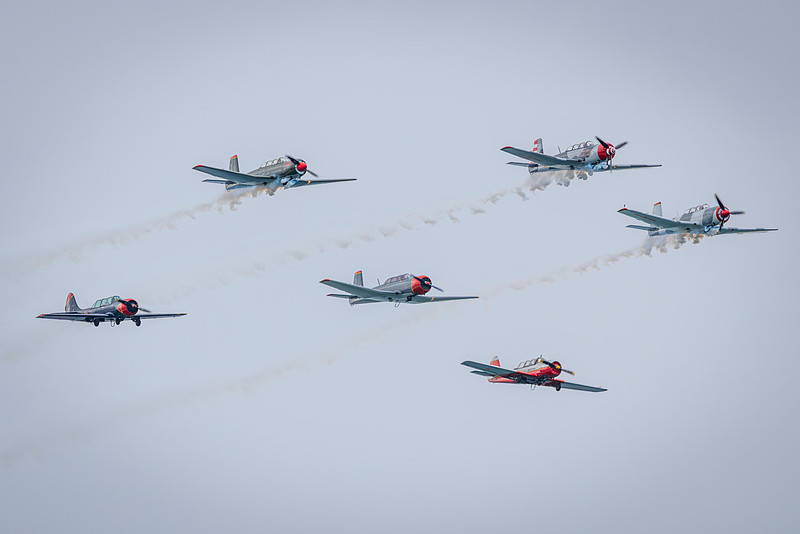 Impressive show!
