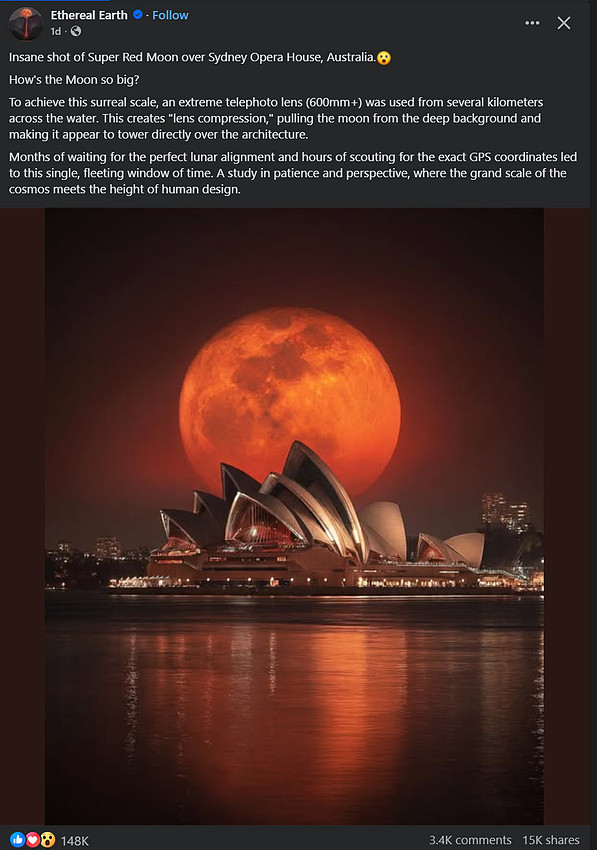
That Blood Moon Lunar Eclipse over the Sydney Opera House?

March 04, 2026  •  Leave a Comment

THIS ... NEVER happened.
Fake or real? REALLY?! "Who was this genius photographer? I want to borrow their cloud removal machine and moon mover."

It fascinates me, people think this is real and give it a ❤️ or 😮. It frustrates me. It genuinely saddens me.

This image has HUNDREDS OF THOUSANDS of reactions.
Thousands of shares.
People wishing they’d “been there to see it.”

But here’s the thing.

No one was there.

Because it didn’t happen.

Andrew wrote:
A true dialogue between human architecture and the grandeur of nature. The case when mathematical calculation of coordinates turns into pure art. 

Amy Theune wrote:
I do like the explanation of the photographer who had to monitor the moon rises, date and times to watch, then uses a super zoom camera to enlarge the moon in the background to depict an artist rendition of “this picture” shows a lot of thought and pre planning and preparation to get the dynamics of the photo, is the work of a very patient intellectual human!

No. No Andrew. No no no Amy! 
It is not the work of a patient intellectual human at all!
This isn’t a photograph.
It’s a fabrication.

And not even a particularly convincing one.

This image is impossible. So what gives it away? 

Let’s Talk Physics, Not Feelings

Yes - telephoto lenses compress distance.
Yes - photographers plan lunar alignments months in advance.
Yes - epic moon shots over landmarks are absolutely possible.
But this image? It breaks the rules of astronomy, geography, optics, and basic observation.
Let’s unpack the reasons why. 

The Size
FACT: Even at 600mm+ from kilometres away, the moon does not appear that large relative to the Sydney Opera House from that vantage point. The harbour in Sydney does not allow the distance.
Compression enhances scale - it does not suspend physics. This moon is oversized beyond realistic proportionality.

The Direction
FACT: Sydney is in the Southern Hemisphere. The orientation and lighting of the moon in this image are clearly a Northern Hemisphere capture. That’s not artistic interpretation. That’s celestial mechanics.

The Timing
FACT: The eclipse here in Australia was not a rising moon. When the moon starts to rise on the East Coast it is still day light. The eclipse in Australia did not occur as a dramatic low-horizon rise directly behind the Opera House. 
By the time totality occurred, the moon was much higher in the sky - and positioned nowhere near this alignment relative to the building.
Also? Last night, the 3rd March 2026 - Sydney was under cloud cover! There was no fiery orb hovering dramatically at 10pm over Circular Quay.

The Reflection
FACT: The reflection in the water is theatrical, but optically inconsistent with the moon’s height and intensity. Water reflections obey geometry. They don’t care about drama.

But It Feels Real…

And that’s their point. :/ And sadly, we’ve entered an era where visual impact overrides plausibility.

Where a confident caption about “months of planning” and “GPS coordinates” is enough to override basic reasoning. Where people trust the aesthetic more than the evidence. This isn’t about one moon photo. It’s about visual literacy. It’s about understanding that not everything spectacular is documentary.

It’s about knowing the difference between:

  • a composite
  • AI generation
  • digital illustration
  • and a real, single-capture photograph

All of which are valid creative tools.

But they are NOT the same thing.

The real issue isn’t the fake: Artists can composite. Creators can generate AI scenes. That’s not the problem.

The problem is presenting fiction as reality - and the public no longer questioning it.

When thousands comment: “I wish I was there to see this.”

That’s not admiration. That’s manipulation. You can’t miss an event that never occurred.
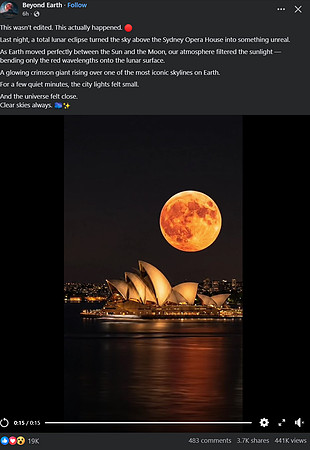
And from Beyond Earth...This was made into a 15 second video! FAKE!

Why This Bothers Me

As photographers, we wake up at 4am.
We scout locations.
We track moon charts.
We study weather radar.
We fail repeatedly before we succeed.

We work with the world as it is.

When fabricated images are framed as “perfect timing” and “intellectual patience,” it diminishes the craft of those who actually do the work.

This image is not the result of astronomical planning. It’s the result of a prompt.

The Bigger Question

If we can’t tell the difference between possible and impossible anymore… what else are we accepting without question?

We don’t need to reject AI. While I don't use Ai in imagery myself, I understand they are a tool. I fid it all too scary, but more scary that many 'think' they are real. 
We don’t need to reject composites. I do lots of them myself, but every single one of them uses only photography I have created myself. And they are presented as composites, not as a single image photograph. 

What we do need, is transparency.

Call it digital art.
Call it an AI render.
Call it a composite fantasy.

Just don’t call it a photograph of something that never ever happened.

Because it didn’t.

And that matters.

Imagine now having the IQ of one of the people who reacted ❤️ or 😮 to this image cos they thought it was real! :/ 
Come on humans, lets get smart hey. 
You're looking at a prompt, not a photograph.


Comments

No comments posted.
Loading...
Subscribe
RSS
Archive
January February March April May June July August (1) September October November December
January February March April May June July August September October November December
January February March April May June July (4) August September October November December (1)
January February March April May June July August September October November December
January (1) February March April May June July (1) August (1) September (1) October November (1) December (1)
January February (1) March April May June July August September October November December
January February (1) March April (1) May June July August (1) September October November December
January February March (1) April May (1) June July (2) August (2) September October November December